|
Hi, I'm Huaze, also go by Patrick. I'm a visiting student at Georgia Institute of Technology working on humanoid whole-body loco-manipulation, agentic self-improvement for whole-body control, and tactile sensing, advised by Prof. Ye Zhao. Previously, I graduated from Harvey Mudd College with high distinction, where I worked with Prof. Adyasha Mohanty on sensor fusion for trustworthy autonomous navigation. I also worked on humanoid robot control and dexterous manipulation under the supervision of Prof. Michael Tolley and Prof. Hao Su at UC San Diego. I'm interested in how tactile feedback can inform a robot's high-level planning to enable whole-body tasks that involve frequent contact or depend on precise contact control. Email / Github / Linkedin / Google Scholar |
|
|
My research focuses on robot whole-body loco-manipulation and navigation. Beyond tactile sensing at the hands, I explore how tactile information from the limbs, torso, and feet can reveal the robot's physical interactions with its surroundings. I investigate how to integrate multimodal signals into high-level planning frameworks, including AI agents and VLA, so that task plans account for where and how the body makes contact. I also explore huamnoid control through self-improvement for long-horizon tasks. |
|
|
|
|
|
Huaze Liu*, Zhenyu Wu*, Jaehwi Jang*, Junjie Sheng, Andrew Collins, Aaron Xie, Zhaoyuan Gu, Kaijie Zhu, Ding Jiang, Kevin Cai, Ye Zhao In submission to ICRA 2027 [Project Page] / [Paper] TL;DR: Vision-denied humanoid navigation through active tactile probing and whole-body control. AbstractNavigation in vision-denied environments is challenging for humanoid robots because proprioceptive odometry drifts and localization uncertainty accumulates rapidly. We present TAPNAV, a tactile active-perception framework that enables humanoid navigation toward a goal by actively probing surrounding structures without relying on vision. TAPNAV maintains a pose belief from odometry, IMU, and tactile contact observations, and couples uncertainty-aware global route planning with information-gain-driven local probing. The global planner searches for routes that keep predicted localization uncertainty bounded by exploiting opportunities for tactile correction, while the local planner selects probe actions that maximize expected information gain. A whole-body controller coordinates the humanoid's locomotion and end-effector contact to execute the planned navigation and probe motions. We evaluate TAPNAV in simulation and on a Unitree G1 across different floor plans and obstacle geometries. TAPNAV achieves lower state estimation error and a higher task completion rate than baselines. These results demonstrate that actively planning physical interactions with the environment can provide localization cues for reliable humanoid navigation without vision. |
|
|
Kehlani Fay*, Arth Shukla*, Huaze Liu, Darin Djapri, Alexiy Buynitsky, Nicklas Hansen 4th RSS Workshop on Dexterous Manipulation; in submission to ICRA 2027 [Project Page] / [Paper] TL;DR: Generalizable egocentric catching, both underhand and overhand. AbstractCatching arbitrary objects requires generalization to novel projectiles and real-time adaptation to unpredictable contact dynamics under noisy visual observations. This paper presents Catch It All!, a sim-to-real catching framework for humanoid robots that generalizes and adapts to unseen objects with variable physical properties for underhand and overhand catches, using only one egocentric camera. We learn policies which generalize to unseen objects with varying geometry, deformability, elasticity, and physical properties. Effective grasps which adapt real-time to object poses and shapes are learned through careful grasp reward design. We provide safety-aware curricula which enable safe, high-frequency action execution near hardware limits, including wrist torque limits as low as 5 N·m. We validate our system by deploying zero-shot on a Unitree G1. With only one egocentric camera, Catch It All! successfully performs underhand and overhand catches on 9 unseen objects not seen during training, including low-rebound plushes, semi-deformable toys and chip bags, and rigid-elastic objects with high rebound on contact. |
|
|
Huaze Liu *, Zihao Gao *, Adyasha Mohanty Proceedings of the Institute of Navigation GNSS+ conference (ION GNSS+ 2025) [Paper] / [Slides] / [Code] TL;DR: Detecting urban map changes from vision and LiDAR, with language-driven explanations of map inconsistencies. AbstractHigh-integrity maps are essential for safe autonomous navigation in dynamic urban environments, where frequent changes and sensor limitations present significant challenges. This paper introduces a novel, deep-learning-driven framework for continuous map uncertainty monitoring and semantic change detection. Our approach leverages data-driven feature extraction from both vision and LiDAR modalities. A key innovation is the integration of zero-shot semantic segmentation using large pre-trained vision-language models, which provides interpretable, language-driven explanations for detected map inconsistencies. The framework dynamically tracks map consistency using Kullback-Leibler divergence metrics, enabling proactive real-time alerts when deviations occur. By jointly assessing structural and semantic integrity, our approach provides a robust and interpretable mechanism for maintaining high-integrity maps in urban autonomous systems. |
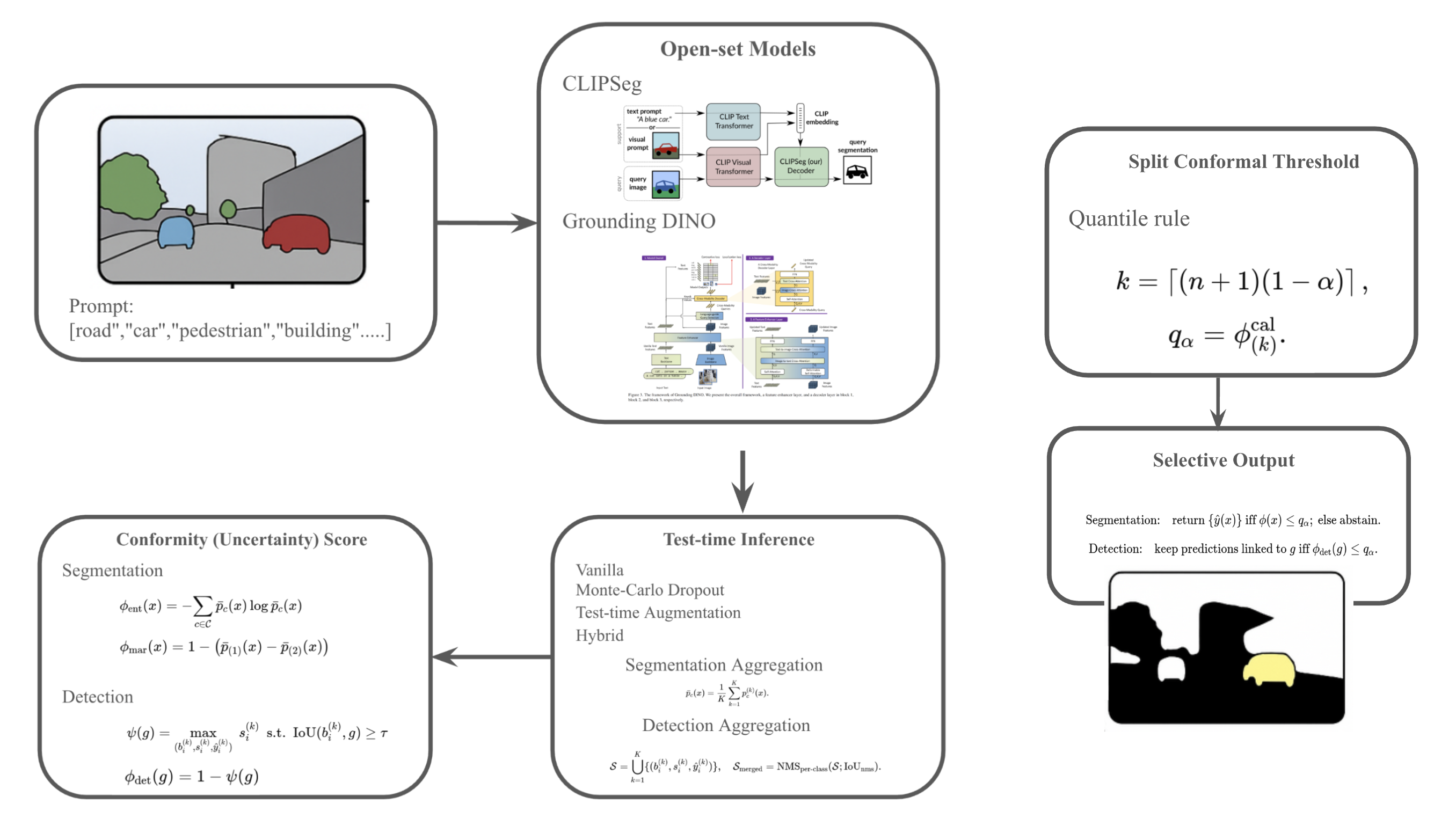 |
Huaze Liu, Adyasha Mohanty Southern California AI and Robotics Symposium 2025 [Paper] |
|
|
|
|
Beyond robotics, I'm also interested in AI agents, computer vision, and ML theory. I regularly maintain and build new projects here. |
|
 |
[Code] Built a manual-grounded AI support agent for the Vulcan OmniPro 220 welder using retrieval over bundled PDF manuals and the Claude Agent SDK, returning page-level citations, manual visuals, and structured wiring/troubleshooting helpers through a Next.js chat UI. |
|
Input
Output
|
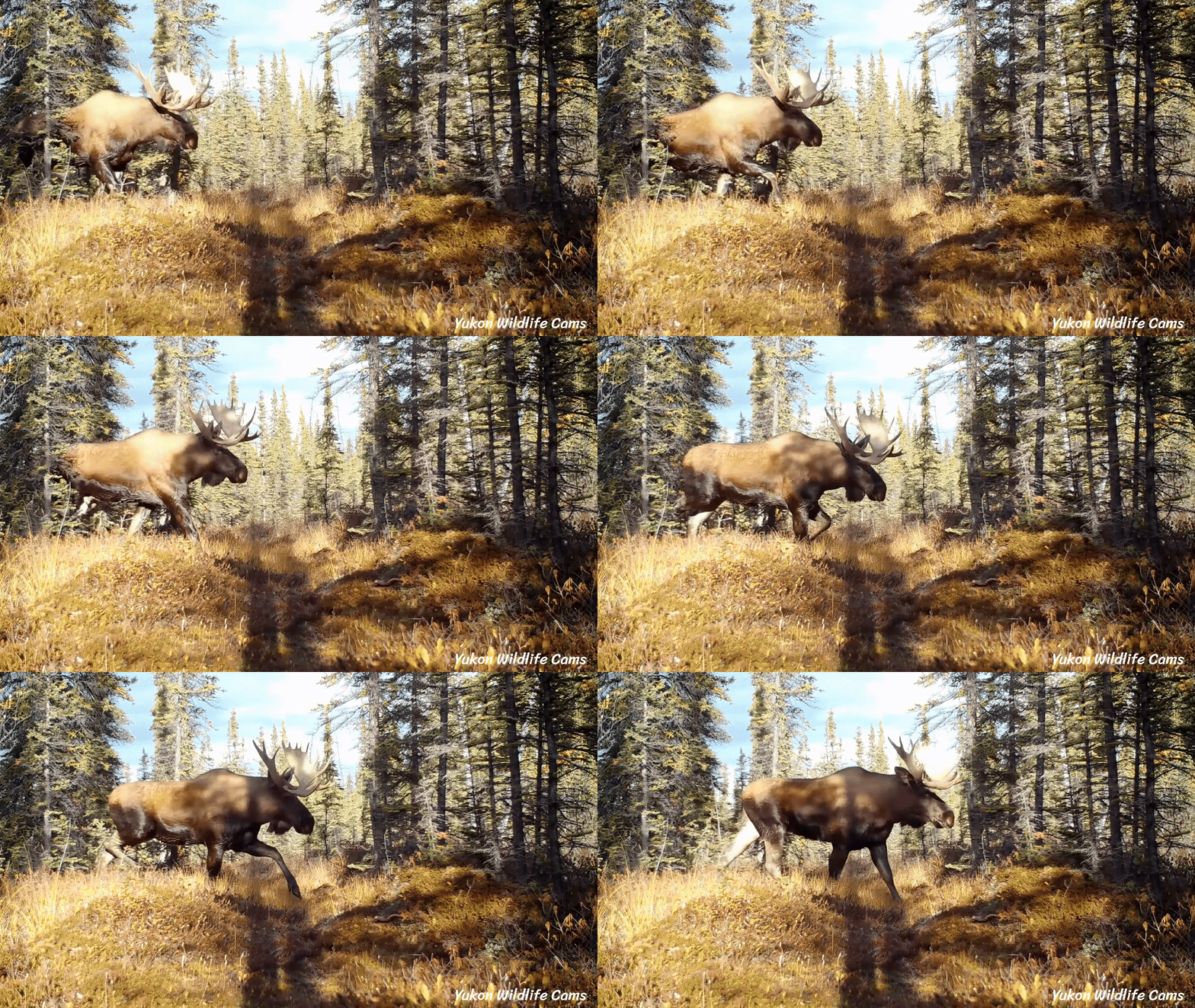
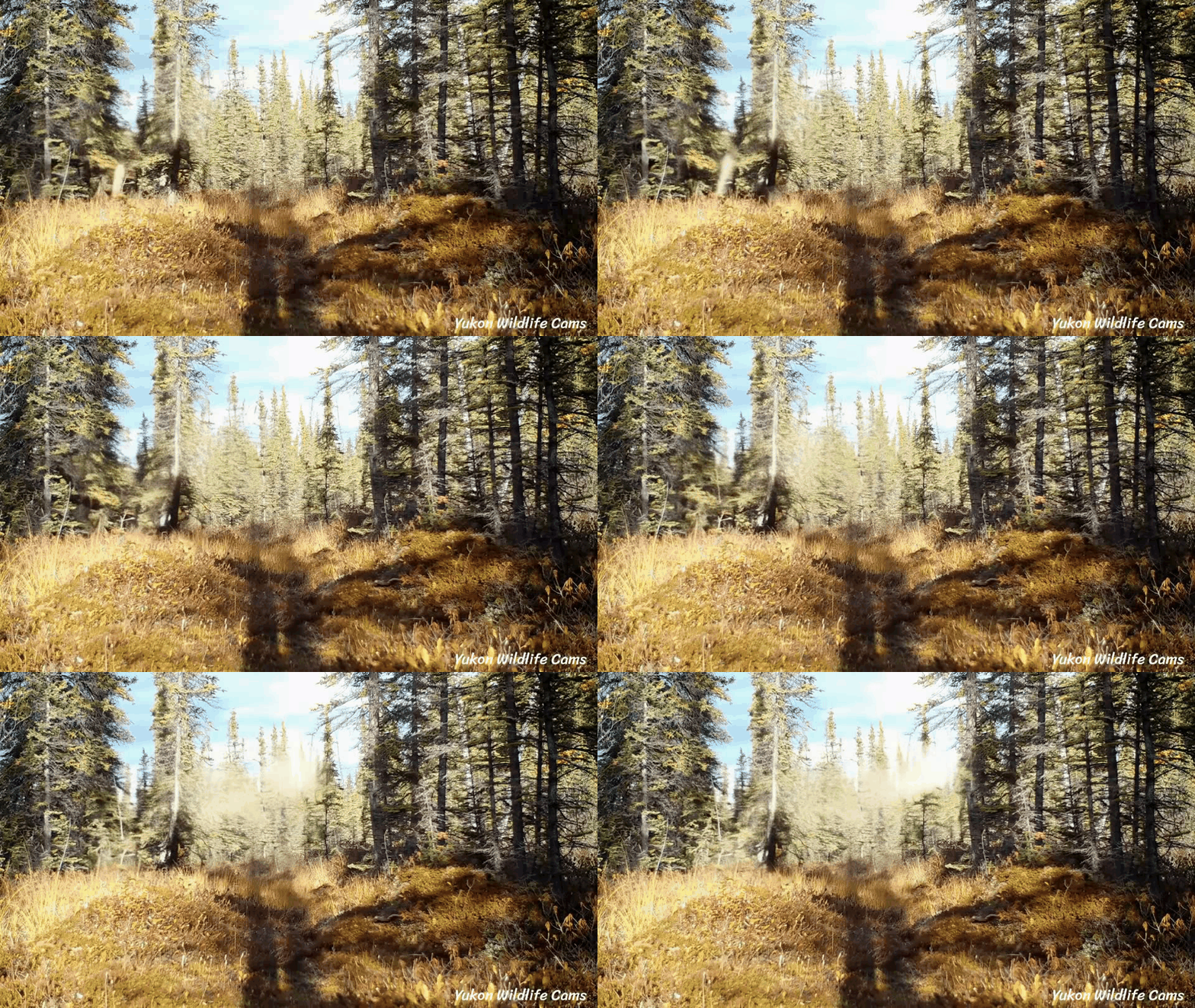
[Code] A reproducible workflow for removing dynamic objects from videos by integrating YOLO for detection, OSTrack for tracking, SAM2 for segmentation, and DiffuEraser for diffusion-based inpainting. The system ensures temporal consistency and high-quality background restoration. |
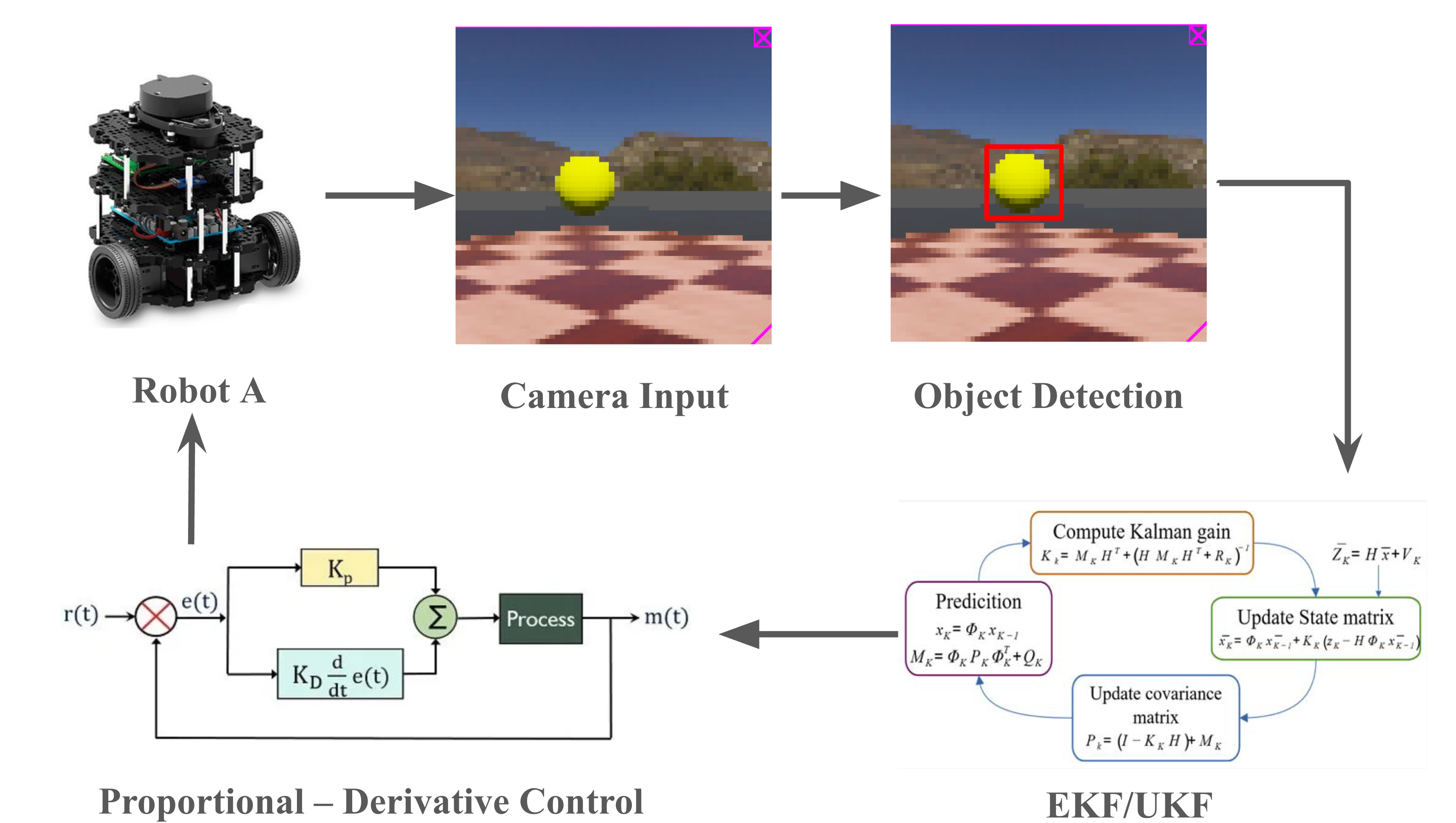 |
[Report] / [Code] Developed a dual-robot system for autonomous emergency response, where an "explorer" robot uses vision-based detection and an EKF/UKF to locate targets and a "rescuer" robot uses the A* algorithm to navigate to them. The framework is validated in the Webots simulator. |
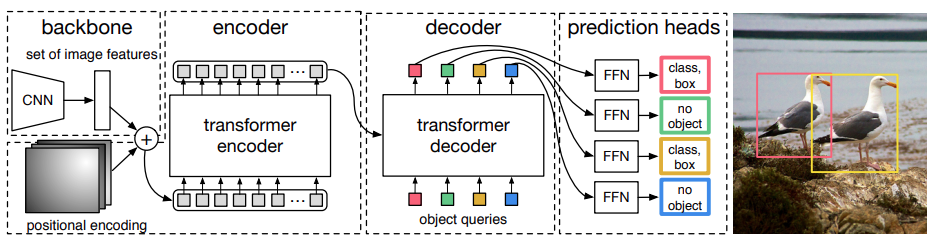 |
[Report] / [Code] Fine-tuned DETR (End-to-End Object Detection with Transformers) for traffic object detection task using KITTI object detection dataset, achieving 71.1% mAP with 18.1ms latency. |
|
|
|
Programming Languages: Python, C++, SQL, C#, Java, MATLAB, LaTeX, R
Frameworks / Libraries: PyTorch, NumPy, Pandas, OpenCV, Scikit-learn, Hugging Face, Flask
Software / Tools: Git, Linux, ROS/ROS2, Isaac Sim/Lab, MuJoCo, SolidWorks, Docker, Jupyter, Visual Studio
Technical Skills: 2D/3D Computer Vision, Deep Learning, Sensor Fusion, Reinforcement Learning, Robotics Control
Hardware Experience: Robots — Franka, TurtleBot, Unitree G1, Booster T1, AgiBot G1; Tactile Sensors — TouchTronix, GelSight, Xela, Daimon
|
|
|
|
Activities: Member of Harvey Mudd RoboSub Team (2022-2023) Awards: Dean's List (2022-2025), $11,000 Shanahan Projects Fund (2024), $3,000 Leeds Student Travel Grant (2025) |